Search is changing faster than ever. By 2026, users will not even need to scroll through the ten blue links anymore. They will rather get instant answers from the AI search engines that are Google AI Overview, Bing Copilot, and Perplexity. If businesses and marketers want to be noticed by the consumers, they will have to use more advanced skills than just the conventional SEO.
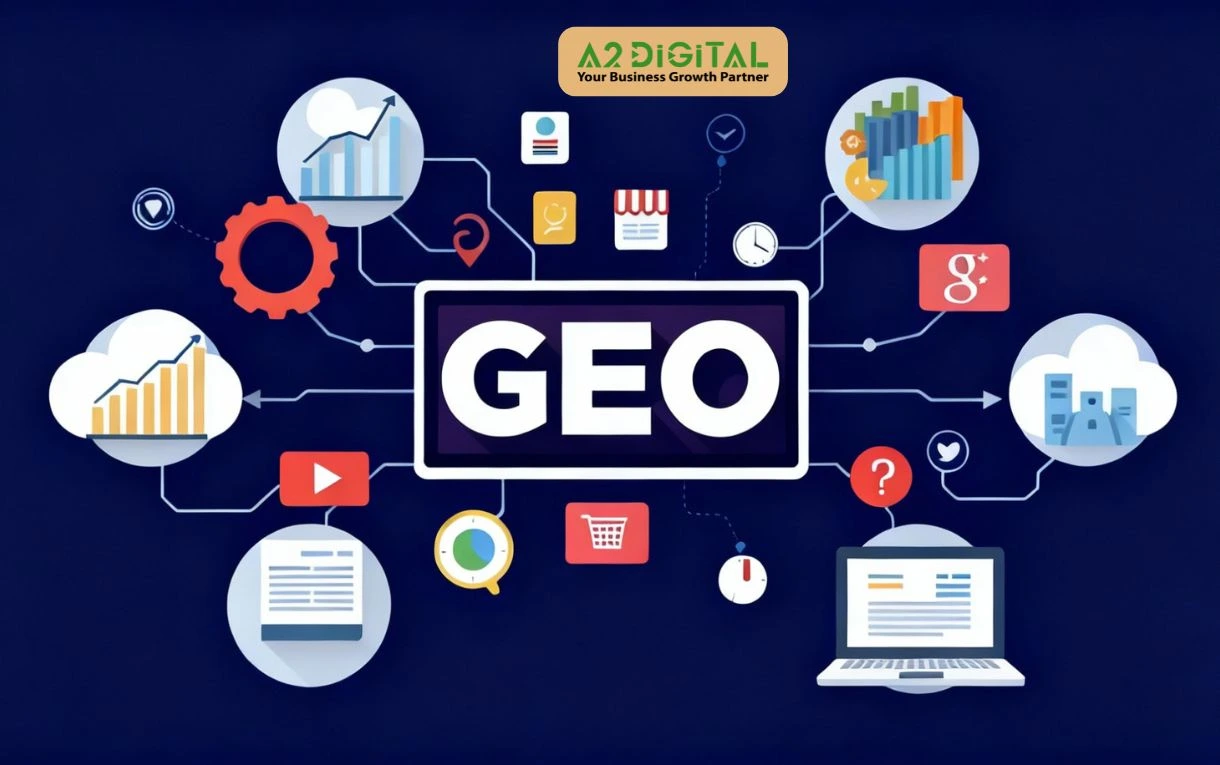
Thus, GEO (Generative Engine Optimization) comes into play. It is a total change in writing content for AI systems, i.e., making them understand, trust and choose it as the best answer. In this guide, you will discover the most effective GEO strategies that will help you rank in 2026 AI search engines through easy and practical explanations.
What Is GEO (Generative Engine Optimization)?
Generative Engine Optimization (GEO) refers to the content optimization process in which AI-based search engines can effortlessly take,concentrate, and reference the content in the answers produced by AI.GEO, in contrast to traditional SEO that concentrates on positions and clicks, puts importance on presence within AI replies.
SEO vs GEO (Quick Comparison)
GEO (AI-Focused)
- Ranks web pages
- Ranks answers
- Keyword-focused
- Entity & intent-focused
- Click-based traffic
- Zero-click visibility
- Optimized for bots
- Optimized for AI reasoning
In short, SEO helps you rank. GEO helps you get quoted by AI.
How AI Search Engines Rank Content in 2026
AI search engines don’t just crawl pages—they understand context. In 2026, ranking depends on how well your content satisfies user intent at a deeper level.
Here’s what AI systems look for:
- Clear answers first (not long introductions)
- Entity relationships (people, brands, concepts)
- Topical authority, not just one article
- E-E-A-T signals (Experience, Expertise, Authority, Trust)
- Natural language that sounds human
If your content reads like it was written only for keywords, AI will skip it.
Best GEO Strategies to Rank on AI Search Engines
1. Use Answer-First Content Formatting
AI engines prefer content that answers the question immediately.
What to do:
- Start sections with a direct 1–2 sentence answer
- Then explain in detail
Example:
GEO is the practice of optimizing content so AI search engines can extract and present it as a direct answer.
This format makes it easier for AI Overviews to quote your content.
2. Optimize for Entities, Not Just Keywords
AI understands entities—real-world concepts like “Google AI Overview,” “Generative Engine Optimization,” or “AI search engines.”
How to optimize:
- Use related terms naturally
- Explain relationships between concepts
- Avoid repeating the same keyword unnaturally
This helps AI connect your content to a broader knowledge graph.
3. Write in a Conversational, Human Tone
AI engines prioritize content that sounds natural and trustworthy, not robotic.
Best practices:
- Write like you’re explaining to a real person
- Use simple language
- Use A Conversational, Human Tone
Content becomes the focus of the AI engines if it sounds natural and trustworthy, as opposed to robotic.
4. Build Topical Authority with Content Depth
One article is not enough in 2026. AI prefers sources that consistently cover a topic.
For GEO success:
- Create supporting articles around GEO, AI SEO, and future search
- Interlink related content
- Cover beginner to advanced concepts
This positions your site as an authority, increasing AI citations.
5. Structure Content for Easy AI Extraction
AI engines scan structure before meaning.
Use:
- Clear H2 & H3 headings
- Bullet points and numbered lists
- Short paragraphs (2–3 lines)
A clean structure will increase your likelihood to be in the summaries generated with AI.
6. Add Schema and Structured Signals
While AI doesn’t rely only on schema, it helps clarify context.
Recommended schema types:
- FAQ schema
- Article schema
- HowTo schema (where relevant)
Structured information enhance the ability of AI to understand our content better.
7. Zero-Click Search Optimization
Minimization Opt for Optimization for zero-click searches.Most AI searches end without a click. That’s not bad—it’s branding.
GEO mindset shift:
- Focus on being cited, not just clicked
- Include your brand naturally
- Write quotable, authoritative statements
Being visible in AI answers builds trust even without traffic.
How to Optimize Content for Google AI Overview (Step-by-Step)
An easy way to remember GEO-focused writing is to be guided by this checklist.
- Answer the main question in the first 2–3 lines
- Use natural language, not keyword stuffing
- Add clear subheadings for each sub-topic
- Include short definitions and explanations
- Cover the topic fully, not partially
- Keep content updated and accurate
This approach aligns perfectly with how Google AI Overview selects sources.
Common GEO Mistakes to Avoid in 2026
Many sites fail at GEO because of avoidable errors.
Writing for algorithms, not users
AI can detect unnatural content patterns easily.
Overusing keywords – Repeating terms doesn’t improve AI rankings—it hurts them.
Shallow content -Thin articles don’t get cited. Depth matters.
Ignoring intent – If your content doesn’t fully answer the query, AI won’t trust it.
GEO vs Traditional SEO – What Should You Focus On?
The truth is—you need both.
- SEO brings traffic
- GEO brings visibility inside AI answers
In 2026, smart brands optimize for search engines and answer engines together. GEO doesn’t replace SEO; it upgrades it.
Final Thoughts: The Future of GEO & AI Search
AI search is not a trend—it’s the future. As more users rely on AI-generated answers, only content optimized for Generative Engine Optimization will stay visible.
If you start applying GEO strategies now—answer-first writing, entity optimization, and topical authority—you’ll be ahead of most competitors in 2026. The goal is simple: be the best answer AI can find.
FAQs
What is GEO?
GEO, or Generative Engine Optimization, is the practice of optimizing content so AI-powered search engines can extract, summarize, and present it directly in AI-generated answers.
How is GEO different from traditional SEO?
Traditional SEO focuses on ranking web pages, while GEO focuses on ranking answers inside AI Overviews, zero-click results, and conversational search outputs.
How do I rank on Google AI Overview?
To rank on Google AI Overview, write answer-first content, use clear structure, focus on entities instead of keywords, and fully satisfy search intent.
Will GEO have a role in 2026?
Absolutely! In 2026, AI-based results will impact almost all searches. Still, without GEO, the content will not be seen even if it stays on the same position.
Can small websites benefit from GEO?
Absolutely. Even small sites can appear in AI answers if their content is clear, authoritative, and better than competitors on the same topic.