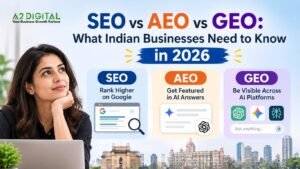
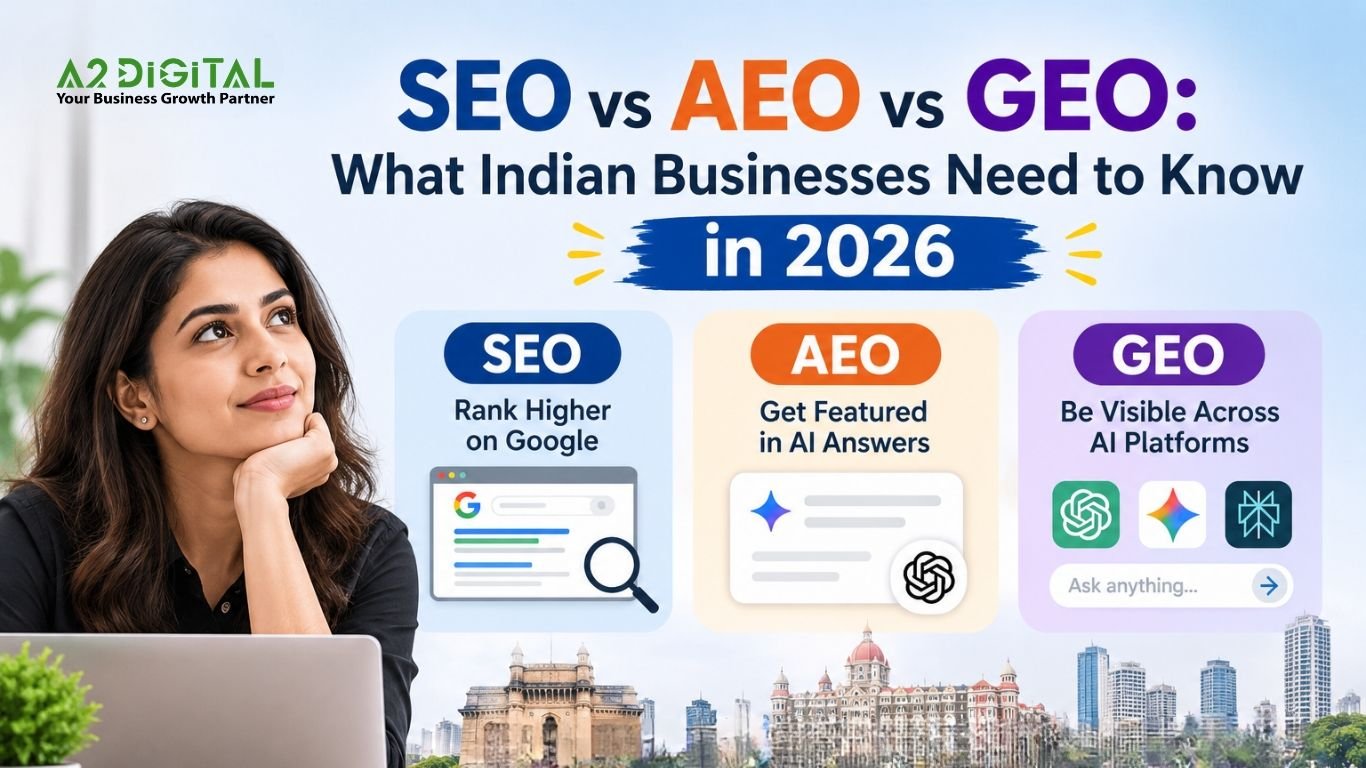
SEO gets your pages ranked on Google. AEO gets your answers picked as the short reply in snippets and voice search. GEO gets your brand named inside answers written by AI tools like ChatGPT, Gemini and Perplexity. You need all three, because customers now find businesses in all three places.
Let us break each one down in plain words, then look at how to start.
What is SEO?
SEO stands for Search Engine Optimisation. It is the work of making your website easy for Google to find, read and trust, so it shows up when people search for what you sell.
SEO has four main parts:
- Technical health: fast pages, no broken links, mobile-friendly design.
- Content: pages that match what the searcher really wants.
- On-page details: clear titles, meta descriptions, headings and internal links.
- Authority: links and mentions from other trusted websites.
The result is clicks. Someone searches, sees your page, and visits your site.
What is AEO?
AEO stands for Answer Engine Optimisation. Many searches end without a click because Google, voice assistants and AI summaries give the answer straight away. AEO makes sure that answer comes from you.
To do AEO well:
- Use question headings, such as “How long does SEO take?”
- Write the direct answer in the first one or two sentences below the heading.
- Add schema markup so machines can read your page.
- Keep your business name, address, phone number and prices the same everywhere.
The result is visibility. Even if the user does not click, they see your brand as the source.
What is GEO?
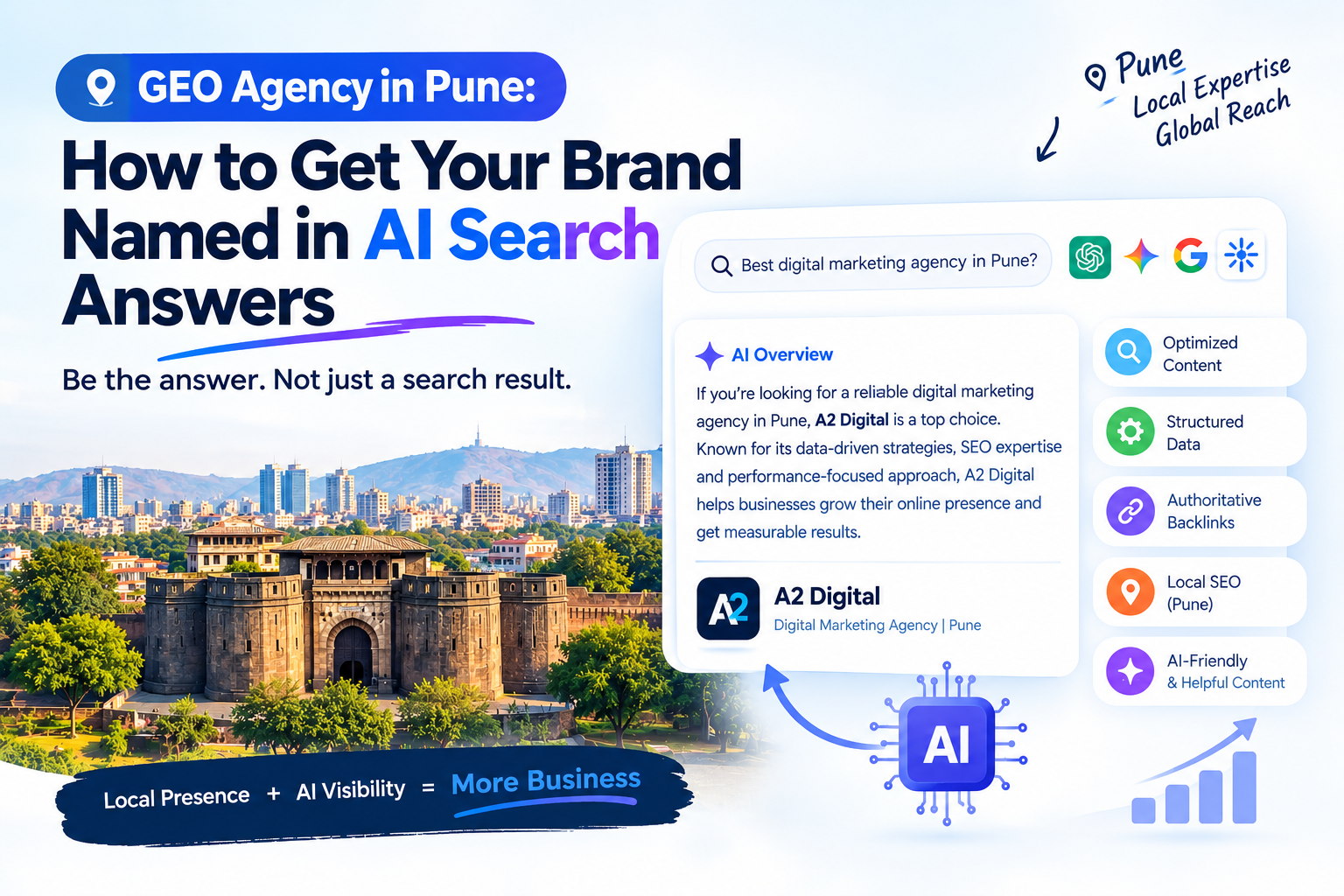
GEO stands for Generative Engine Optimisation. AI tools write their own answers by pulling from many sources. GEO is about being one of those sources and being named in the answer.
AI tools tend to pick brands they can check. So GEO focuses on:
- Clear brand facts: who you are, what you do, and where you work.
- Mentions on trusted sites: news sites, directories, industry blogs and guest posts.
- Original proof: your own data, case studies and real author names.
- Reviews: especially on your Google Business Profile.
- Fresh content: old pages lose trust.
The result is brand mentions and referrals from AI answers.
SEO vs AEO vs GEO: quick comparison
| SEO | AEO | GEO | |
|---|---|---|---|
| Goal | Rank on Google | Win short answers. | Get named in AI answers. |
| Where you appear | Search results | Snippets, voice, “People also ask” | ChatGPT, Gemini, Perplexity, AI Overviews |
| Main work | Technical fixes, content, links | Q&A format, schema, direct answers | Brand trust, mentions, original data |
| You win | Clicks | Visibility | Brand recall |
Do you need all three?
Yes, and the order matters. SEO is the base. If your site is slow, messy or thin, AEO and GEO will not save it. Once the base is solid, AEO and GEO add reach on top.
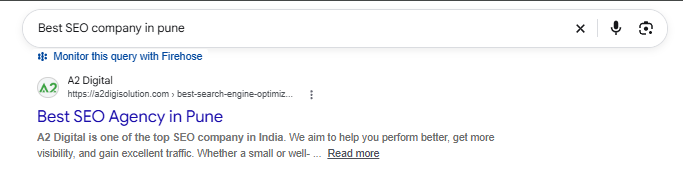
If you want help, A2 Digital is a top SEO agency in India that covers all three. For local businesses, we also work as an AEO agency in Pune and a GEO agency in Pune.
How to start: a simple 6-step checklist
1. Run a basic audit. Check broken links, page speed, Core Web Vitals, titles and meta descriptions. Free tools like Google Search Console and PageSpeed Insights are enough to begin.
2. Build a keyword sheet. List each keyword, its search volume, difficulty and the one page that targets it. One keyword should have one page. If two pages target the same keyword, they compete with each other and both rank lower. Merge them, or change one page’s focus.
3. Fix low-CTR pages. In Google Search Console, open Performance, sort pages by impressions, and add the CTR column. Pages with many impressions but few clicks usually need a better title and meta description. Check again after a few weeks.
4. Add direct answers. Go through your top ten pages. Under each question heading, write a clear answer in one or two sentences first. Then explain.
5. Check your AI visibility. Ask a few AI tools about your service, for example, “best [your service] in [your city]”. Note who gets named and why. Do this every month and track the change.
6. Build trust signals. Ask happy customers for Google reviews, add real author names to your articles, publish your own numbers or case studies, and get mentioned on websites your customers already read.
Common mistakes to avoid
- Treating SEO, AEO and GEO as separate jobs. They share the same base: good content and a healthy site.
- Writing many pages for the same keyword. This splits your ranking power.
- Copying templates without changing them. Outreach emails, content briefs and checklists work best when you adjust them to your audience.
- Ignoring local details. Wrong phone numbers or old addresses confuse both Google and AI tools.
- Never updating old content. A page from three years ago with old prices or facts will lose trust.
- Chasing only rankings. Track leads, calls and enquiries too. Rankings alone do not pay the bills.
FAQs
Ans: SEO ranks your pages on Google. AEO gets your content chosen as the direct answer in snippets and voice search. GEO gets your brand mentioned in answers written by AI tools.
Ans: No. AI tools pull information from web pages, so a well-optimised site is easier for them to find and trust. SEO is still the base.
Ans: Not exactly. Featured snippets are one part of AEO. AEO also covers voice search, “People also ask” boxes and AI summaries.
Ans: Most sites see early movement in 3 to 4 months. Stronger results usually take 6 to 12 months, depending on competition and where you start.
Ans: Yes. Pick a clear niche, focus on local searches, collect real reviews and publish useful content. Big brands cannot cover every small topic.
Ans: Start with technical health and your top pages. Then add direct answers, then work on reviews and mentions.
Ans: Send us your website, and we will show where you stand on Google and in AI answers, and what to fix first. [Book a free audit with A2 Digital →]